
SEO ROI: Measuring Value of Organic Search

Is organic search actually paying off, or just generating vanity traffic? This guide breaks down how to answer that for a cybersecurity company: what SEO ROI means, how to calculate it, which metrics actually tie back to revenue, realistic benchmarks, and the most common mistakes that make SEO look less effective than it really is.
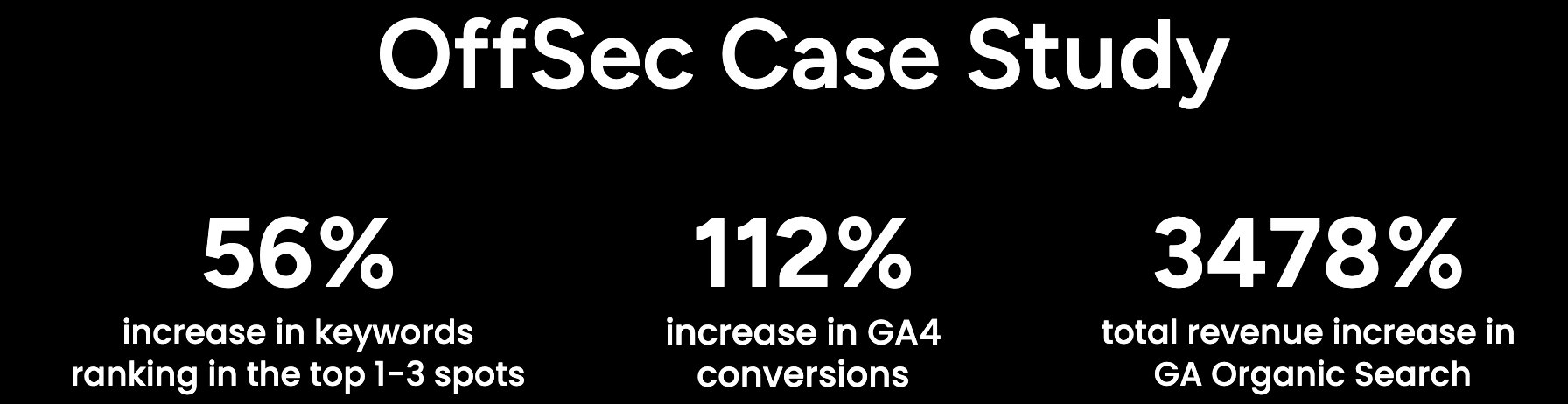
- SEO can produce returns far beyond traffic growth alone. Amplifyed client OffSec saw a 3,478% increase in organic revenue year to date after aligning technical SEO, content, and conversion paths.
- AI search is already producing measurable ROI, not just visibility. OffSec’s ChatGPT-driven sessions increased 2,400%, with conversions from that traffic up 4,900%, showing GEO work can convert, not just generate mentions.
- Measuring SEO ROI well requires the right reporting setup, not just the right metrics. Amplifyed builds custom dashboards that connect Google Analytics and Search Console data to pipeline and revenue, so clients can see SEO’s business impact clearly instead of estimating it.
What Is SEO ROI?
SEO ROI is the return generated from organic search compared with the cost of your SEO investment. It measures whether your SEO efforts are producing enough business value to justify the money, time, and resources behind them. That return can show up in several ways, including closed-won revenue from organic leads, demo requests, qualified leads, sales opportunities, influenced pipeline, or estimated lead value.
A complete SEO ROI calculation should account for more than direct content or agency costs. It should include strategy, content, technical SEO, SEO tools, agency support, developer time, link building, reporting, and internal team hours. For cybersecurity companies, this matters because buyers often research risks, frameworks, product categories, and vendor comparisons before speaking with sales, which means organic content can educate prospects early and bring them back when they are ready to evaluate a solution.
How Do You Calculate SEO ROI?
The standard SEO ROI formula is:
SEO ROI = [(Revenue from SEO - Cost of SEO) / Cost of SEO] x 100
For example, if SEO generated $150,000 in revenue and the total SEO investment was $50,000, the SEO ROI calculation would be:
[($150,000 - $50,000) / $50,000] x 100 = 200%
That means the company earned $2 back for every $1 invested after covering the cost.
The harder part is deciding what counts as revenue from SEO. A mature attribution setup may connect organic search directly to closed-won deals. Earlier-stage teams may need to estimate revenue using lead value, assisted conversion data, opportunity value, or influenced pipeline. A practical SEO ROI calculator should reflect the way your company actually tracks leads and revenue.
.png)
Common SEO Cost Categories
SEO ROI is only useful if the cost side of the calculation is complete. Many teams count obvious expenses like agency fees or content production, but miss internal time, technical implementation, tools, and ongoing optimization.
To calculate total SEO investment accurately, include the main cost areas behind the work:
- Content production: New blog posts, landing pages, comparison pages, case studies, and other SEO-focused assets.
- Content refreshes: Updates to older pages with stronger structure, fresher data, better FAQs, and improved internal links.
- Technical fixes: Work that improves crawlability, indexation, site speed, redirects, schema, and page performance.
- SEO tools: Platforms used for keyword research, rank tracking, site audits, reporting, and competitor analysis.
- Developer support: Technical implementation help for site changes, templates, redirects, structured data, or CMS updates.
- Link building: Outreach, digital PR, and authority-building efforts that help improve trust and search visibility.
- Agency fees: External SEO strategy, execution, reporting, content guidance, and ongoing optimization support.
Including these costs gives leadership a more accurate view of SEO cost, profit margin, and potential ROI. It also prevents teams from overstating SEO return by leaving out internal labor or technical implementation.
Why Is SEO ROI Hard to Measure?
Measuring SEO ROI is not always straightforward because SEO results build over time and attribution is rarely clean. Rankings, traffic, domain authority, conversions, and sales influence do not always move at the same pace. In cybersecurity, a buyer may read an educational blog post, return later through branded search, review a comparison page, attend a webinar, and then convert through a demo page months later. If the company only uses last-click attribution, the final touchpoint gets the credit while earlier SEO activity disappears from the story.
Direct Conversions vs. Assisted Pipeline
Teams should look at both direct organic conversions and assisted pipeline because SEO may not always be the final touch before a sale, but it can shape buyer understanding and trust earlier in the journey. Google Analytics, CRM data, attribution tools, and call tracking can help, but they need to be set up carefully so marketing teams can tag key forms, track conversion paths, separate organic traffic by intent, and connect SEO activity to sales outcomes wherever possible.
What SEO Metrics Should Cybersecurity Teams Track?
SEO ROI depends on more than one metric. A useful reporting system should show whether SEO is increasing visibility, attracting the right visitors, and creating business value instead of only reporting traffic growth.
Visibility and Traffic Metrics
Start with visibility and traffic metrics to see whether your SEO campaign is gaining reach in search results. These numbers show if your pages are being discovered, clicked, and visited by the right audience.
- Organic sessions: Show how many visits are coming from unpaid search.
- Impressions: Show how often your pages appear in search results, even before users click.
- Keyword rankings: Track whether priority terms are moving up, down, or staying flat.
- Non-branded keyword growth: Measure visibility for searches that do not already include your company name.
- Click-through rate: Show whether searchers are choosing your result after seeing it in the SERP.
- Page-one keyword gains: Track how many keywords move into the first page, where visibility is much higher.
- Traffic by intent: Separate educational blog traffic from high-intent traffic on solution, comparison, industry, and compliance pages.
These metrics show whether your SEO campaign is gaining traction, but they should not be reviewed in isolation. A rise in impressions or traffic is more useful when it connects to relevant keywords, qualified visitors, and pages that can move buyers closer to conversion.
Conversion and Revenue Metrics
Visibility only matters if it helps move buyers closer to action. Track conversion and revenue metrics to see whether organic search is creating leads, sales opportunities, and measurable pipeline.
- Demo requests: Show how many organic visitors are ready to speak with sales or view the product.
- Form fills: Track contact form submissions, consultation requests, and other inquiry actions from organic traffic.
- Gated asset downloads: Measure interest in guides, reports, checklists, webinars, or other lead magnets.
- MQLs: Show how many organic leads meet your marketing qualification criteria.
- SQLs: Track which organic leads are accepted by sales as real opportunities.
- Opportunities: Connect organic search to active sales pipeline.
- Pipeline value: Estimate the potential revenue tied to SEO-influenced opportunities.
- Closed-won revenue: Show the actual revenue generated from leads or accounts influenced by organic search.
Together, these SEO KPIs help teams move beyond “traffic went up” and toward a clearer view of SEO success. The strongest reports connect visibility, intent, conversions, and revenue so leadership can see how SEO supports growth.
Let's talk about what Amplifyed's SEO can do for your team.
How Should Cybersecurity Companies Think About SEO ROI?
Cybersecurity companies should frame SEO ROI around buyer behavior. Security buyers are cautious because the stakes are high. They want to understand risk, compare approaches, check proof, review compliance needs, and assess whether a vendor understands their environment.
SEO Builds Trust Before Sales Conversations
SEO plays a trust-building role before buyers ever contact sales. Thought leadership, technical explainers, comparison pages, compliance guides, and use-case content can help buyers learn, compare, and validate your expertise earlier in the journey.
Lead Quality Matters More Than Traffic Volume
A smaller number of high-intent visitors can be more valuable than broad traffic from generic cybersecurity terms. A page ranking for a specific compliance or product-comparison keyword may produce fewer visits than a general blog post, but those visitors may be much closer to a buying decision.
For this reason, cybersecurity teams should evaluate SEO by account fit, buying intent, opportunity value, and sales relevance. Broad traffic has a place, especially for awareness, but ROI usually improves when the SEO strategy prioritizes content closer to revenue.
What SEO ROI Benchmarks and Statistics Should You Know?
SEO ROI statistics can help teams set expectations, but they should be used carefully. The SEO return a company sees depends on site authority, competition, content quality, technical health, conversion rate, deal size, sales cycle length, and the total SEO investment behind the program.
Use Benchmarks as Context, Not Guarantees
A benchmark from another industry may not apply cleanly to cybersecurity. A small business running local SEO has a very different path to ROI than a cybersecurity company selling an enterprise platform with a six-month sales cycle. Even within cybersecurity, ROI expectations can vary between an MSSP, compliance platform, cloud security company, and early-stage startup.
Use Real Cybersecurity SEO Results When Possible
The most useful SEO ROI statistics are the ones tied to your own funnel or to comparable cybersecurity campaigns. For example, Amplifyed’s Castra case study showed 49 page-one keywords, up from 10, along with a 64% increase in organic traffic after the introduction of Amplifyed SEO. This gives cybersecurity teams a more relevant reference point than broad industry averages.
Amplifyed’s OffSec case study also shows why SEO ROI should be tied to business outcomes, not rankings alone. Organic Search sessions increased, GA4 conversions rose 112%, and total organic revenue increased 3,478.12% year to date. These results show how technical SEO, content optimization, and conversion improvements can work together to create measurable business value.
How Can You Improve SEO ROI?
The fastest path to higher ROI is often to prioritize pages closest to revenue. These pages usually have clearer buying intent and better potential to influence the pipeline than broad educational posts.
Prioritize Pages Closest to Revenue
Not every SEO page has the same business value. To improve ROI, start with pages that match stronger buyer intent and have a clearer path to demos, sales conversations, or pipeline.
Focus first on:
- Solution pages: Target buyers actively searching for a specific product, platform, or service category.
- Comparison pages: Capture prospects evaluating vendors, alternatives, features, pricing, or product fit.
- Industry pages: Speak to buyers searching for solutions built around their sector, such as finance, healthcare, government, or SaaS.
- Use-case pages: Address specific problems, workflows, or outcomes that buyers are trying to solve.
- Compliance-related pages: Attract high-intent searches tied to frameworks, audits, regulations, and security requirements.
Improve these pages with stronger keyword alignment, clearer CTAs, proof points, internal links, product context, and conversion paths. The goal is not only to rank. The page also needs to help the right buyer take the next step.
Refresh Existing Content
Refreshing existing content can often improve SEO ROI faster than creating only new content because pages with page-two rankings, declining traffic, strong impressions, or past conversions already have some equity. Update these pages with fresh statistics, better sources, stronger headings, natural FAQs, improved internal links, clearer next steps, and stronger search intent alignment before spending more budget on new assets.
What Mistakes Can Lower SEO ROI?
One common mistake is measuring SEO by traffic alone. Traffic without qualified leads, demo requests, assisted pipeline, or revenue does not prove positive ROI, especially in cybersecurity where broad educational visits may not reflect real buying intent. The better approach is to segment traffic by intent so teams can separate casual readers from real buyers and measure high-intent pages by lead quality, conversion rate, and pipeline contribution.
Technical and Conversion Issues
Another mistake is ignoring technical and conversion issues. Crawl problems, slow pages, weak internal links, poor site structure, and missing schema can limit rankings even when the content is strong. These issues reduce the value of every SEO effort because they make it harder for search engines and users to access the page.
Weak CTAs can also lower SEO ROI. If a page ranks well but gives visitors no clear next step, the business value is limited. Unclear demo paths, thin proof points, generic messaging, and missing case studies can reduce conversion rates even when traffic improves. SEO ROI improves when technical SEO, content quality, and conversion strategy work together.
How Long Does It Take to See SEO ROI?
SEO ROI usually takes time, but the timeline depends on your starting point. Technical fixes, content refreshes, improved internal links, or pages already close to ranking can create early gains, while larger ROI gains often take longer because authority, rankings, traffic, and conversions build gradually.
Report Progress in Stages
SEO ROI is easier to explain when reporting shows progress before revenue arrives. Instead of waiting for closed-won deals, track early signals that show whether your SEO work is building visibility, attracting the right audience, and moving users closer to conversion.
Early indicators include:
- Indexation: Confirm that important pages are being crawled and indexed properly.
- Impressions: Track whether your pages are appearing more often in search results.
- Ranking movement: Monitor whether priority keywords are moving closer to page one.
- Traffic: Measure growth in organic visits from search engines.
- Engagement: Review time on page, scroll depth, bounce rate, and other signals that show whether visitors find the content useful.
- Conversions: Track demo requests, form fills, downloads, or other actions that show SEO is starting to support business goals.
As the SEO campaign matures, connect reporting to qualified leads, opportunity value, pipeline, and closed-won revenue. That staged view makes measuring SEO ROI more practical because it shows both early progress and later business impact.
Turn SEO ROI Into a Smarter Growth Metric
SEO ROI should help cybersecurity companies understand how organic search contributes to real business outcomes, not just how much traffic a site receives. Strong ROI depends on the right keywords, technical foundations, content quality, conversion paths, and attribution model. It also depends on patience because SEO is an ongoing growth channel that becomes more valuable when teams keep improving the pages, links, and conversion paths that matter most.
Amplifyed helps cybersecurity companies connect SEO strategy to qualified pipeline and measurable growth. If your team wants to understand where organic search is creating value, where performance is leaking, and which SEO initiatives could produce a higher ROI, start by reviewing your current SEO performance and identifying the highest-impact opportunities for improvement.
FAQs