
Cybersecurity companies face a unique SEO challenge. Your buyers (CISOs, SOC managers, compliance officers) are among the most skeptical, research-intensive audiences in B2B. They can spot shallow content immediately. Generic "IT security tips" articles won't earn their trust or their clicks in search engine results.
The cybersecurity market is crowded and getting more competitive every quarter. Ranking well requires more than basic on-page optimization. It demands content that reflects a genuine understanding of threats, frameworks, and the operational realities security teams face daily.
This guide explains how cybersecurity companies can build an SEO program that ranks for the right keywords, attracts qualified leads, and supports trust with technical buyers. It also shows how to establish lasting credibility with technical buyers looking for a cybersecurity company on Google search.
Why Cybersecurity SEO Needs a Different Approach
Most B2B search engine optimization (SEO) playbooks fall short for cybersecurity. The industry operates on a level of complexity that general tech marketing rarely touches. Cyber threats shift monthly. Compliance requirements vary by sector. Buyers evaluate vendors based on technical depth, not marketing polish.
Many cybersecurity companies make the same mistake, they invest heavily in website design and paid campaigns while underinvesting in specialized content. The result is a polished cybersecurity website that looks professional but reads like it was written by someone who's never worked a SOC shift or sat through a compliance audit.
An effective SEO strategy mirrors how security professionals actually research cybersecurity solutions. They search for specific threats, compare tools against known frameworks, and look for evidence that a vendor understands their environment. Your content strategy must reflect this behavior.
Industry-specific vocabulary matters. Terms like "lateral movement," "IOC enrichment," or "CMMC Level 2" carry precise meanings. Using them correctly signals expertise. Using them incorrectly, or avoiding them entirely, signals the opposite.
The stakes are high. Security buyers know that choosing the wrong vendor can mean breaches, regulatory fines, or career-ending incidents. Vague or inaccurate content doesn't just fail to convert. It actively erodes trust.
How Industry-Specific Content Improves Cybersecurity SEO
Create Content That Speaks Directly to Cybersecurity Challenges
Cybersecurity buyers search for content that addresses real problems. They're dealing with ransomware variants that bypass traditional defenses, cloud misconfigurations that expose sensitive data, and Zero Trust rollouts that stall due to legacy infrastructure. Strong security content should reflect these problems with enough depth to earn trust from technical readers.
Your content must reflect these realities. Write about SOC alert fatigue and how it leads to missed detections. Explain the security implications of OT/IT convergence in manufacturing environments. Address identity sprawl in organizations juggling dozens of SaaS applications.
Improve SEO Performance by Targeting Niche Security Keywords
Cybersecurity SEO requires tighter keyword targeting than most industries. Broad terms like "IT security" or "Azure Security" attract high volume but low intent. They also pit you against massive competitors with established domain authority.
Focused keywords perform better. "SOAR platform for mid-market" or "healthcare cybersecurity compliance" reach smaller audiences, but those audiences are actively looking for solutions. Specificity improves relevance, click-through rates, and SEO rankings for terms that are more likely to attract qualified buyers.

The math is straightforward: ranking #3 for a 500-search-per-month keyword with strong commercial intent will generate more qualified leads than ranking #15 for a 10,000-search-per-month generic term.
Build Trust With Expert-Level Content
Cybersecurity purchasing decisions hinge on trust. Buyers need confidence that a vendor can actually protect their organization, not just claim to.
Detailed, accurate content builds that confidence. Case studies showing measurable outcomes. Framework-aligned explanations that reference the NIST Cybersecurity Framework, MITRE ATT&CK, or CIS Controls. Threat analysis that demonstrates current awareness. Regulatory insights that prove you understand compliance burdens.
This type of content reduces friction throughout the sales cycle. Prospects arrive at demos already educated on your approach. Sales conversations start further down the funnel.
Stand Out in a Crowded Cybersecurity Market
The cybersecurity vendor market has exploded. Thousands of companies now compete for attention from the same pool of security buyers. Most of them publish the same generic content: "Top 10 Cybersecurity Best Practices" and "Why You Need Endpoint Protection."
Niche content differentiates you. A detailed guide on securing operational technology environments positions you as a specialist to OT security teams. An in-depth comparison of threat intelligence platforms for government contractors speaks directly to that audience's procurement requirements.
Security buyers gravitate toward specialists. When your content demonstrates focused expertise, you stop competing with everyone and start competing only with vendors in your specific category. We cover this approach more in depth in our cybersecurity content marketing guide.
High-Intent Cybersecurity SEO Keywords: What Actually Drives Revenue
Cybersecurity search intent falls into three main categories: educational (learning about a topic), evaluational (comparing approaches or vendors), and purchase-ready (looking for a specific solution). A focused keyword search process helps cybersecurity teams identify which terms signal early research, active comparison, or readiness to evaluate a specific solution.
High-intent keywords, those with evaluational or commercial intent, drive the most revenue and qualified leads.
Here are examples:
The people searching these terms are CISOs evaluating new investments, security engineers researching tools, and compliance managers looking for audit-ready solutions. They're not casual browsers. They're actively working toward a decision. Learn more about converting organic traffic in our guide to B2B cybersecurity lead generation.
Group These Keywords Into Strategic Clusters
Organizing keywords into clusters builds topical authority and prevents content overlap. Each cluster should have a pillar page supported by related subtopic content, all interlinked to reinforce authority.
Here are four high-value clusters for cybersecurity companies:
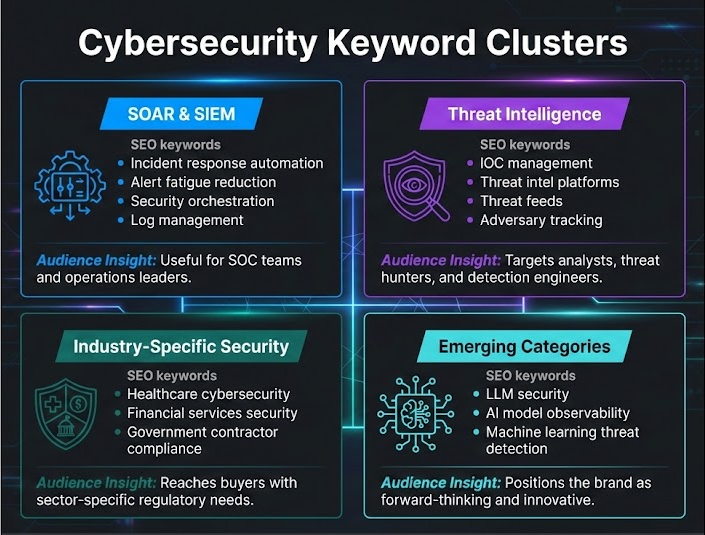
Common cybersecurity SEO clusters include SOAR and SIEM, threat intelligence, industry-specific security, and emerging categories such as LLM security or AI model observability. Each cluster should connect a pillar page, supporting blog content, and relevant solution pages so search engines can understand the relationship between topics.
Scaling Organic Growth with Cybersecurity Content Hubs
Topic clusters matter more in cybersecurity than in most industries. The technical depth required means isolated articles rarely build enough authority to rank competitively. Content hubs (pillar pages supported by interlinked subtopic content) consolidate authority and create clearer user journeys for security companies competing in crowded search results.
This structure improves navigation, builds subject matter authority, and creates a clear topical hierarchy that supports visibility in AI-generated search results.
Example of a Strong Hub Structure
Pillar Page: Ransomware Protection for Enterprises
Supporting Content:
- Backup strategies that withstand ransomware attacks
- Ransomware recovery playbooks for security teams
- Employee security awareness training for ransomware prevention
- Common ransomware attack vectors and entry points
- Ransomware vs. extortionware: understanding the differences
- Incident response templates for ransomware events
Each subtopic page links to the pillar. The pillar links out to each subtopic. Solution pages and downloadable resources connect throughout.
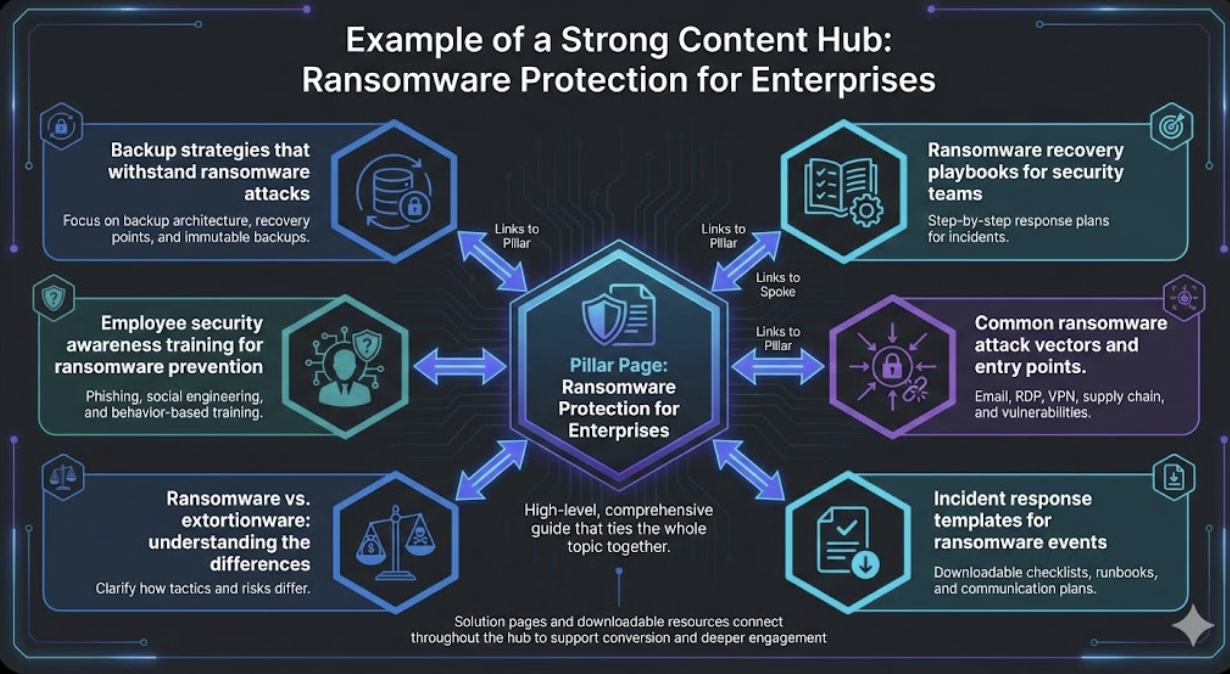
This structure improves navigation, builds subject matter authority, and creates a clear topical hierarchy that supports visibility in AI-generated search results.
Build a Content Strategy with Amplifyed
Aligning Content with the Cybersecurity Buyer Journey
Cybersecurity purchases involve multiple stakeholders with different priorities. A CISO focuses on risk reduction and board reporting. A SOC manager cares about operational efficiency. A compliance officer needs audit documentation. Each searches differently.
TOFU: Early Stage Educational Content
Top-of-funnel content answers foundational questions and frames problems:
- "What is LLM observability?"
- "Types of cybersecurity audits explained"
- "Zero Trust vs. perimeter-based security models"
The goal is awareness. Help readers understand their challenges before they start evaluating solutions.
MOFU: Evaluation and Comparison Content
Middle-funnel content helps buyers compare approaches and narrow their options:
- "Best threat intelligence platforms for government agencies"
- "SIEM vs. SOAR: which does your SOC need?"
- "How to evaluate MDR providers"
The goal is education during active evaluation. Position your approach within the broader market.
BOFU: Bottom-of-Funnel Commercial-Intent Content
Bottom-funnel content converts researchers into leads:
- Solution pages with feature details and use cases
- Case studies showing measurable outcomes
- Competitor comparison pages
- Downloadable resources like incident response playbooks
The goal is helping buyers choose a vendor, ideally you.
E-E-A-T in Cybersecurity SEO: What It Really Means
Cybersecurity content falls into a category Google scrutinizes heavily. Inaccurate security advice can cause real harm: breaches, compliance failures, financial losses. Google's quality guidelines treat this type of content with extra skepticism.
Demonstrating Experience, Expertise, Authoritativeness, and Trustworthiness (E-E-A-T) requires deliberate effort:
Demonstrate Author Credentials and Expertise
Include detailed bios listing certifications (CISSP, CEH, CISM), industry experience, and relevant background. Anonymous content struggles to build trust.
Involve Subject Matter Experts
Have subject matter experts draft or review technical content. Their input improves accuracy and credibility.
Cite Authoritative Sources
Reference established frameworks like NIST, MITRE ATT&CK, and OWASP. Link to primary sources for statistics and claims.
Publish Original Research
Publish threat trend analysis, survey data, or incident pattern research. Original insights attract links and establish authority.
Maintain Fresh Content
Review and refresh key content every 6 to 12 months. Outdated cybersecurity advice damages credibility and can harm readers who follow it.
Technical SEO Foundations for Cybersecurity Websites
Cybersecurity buyers expect reliability and performance. A slow, poorly structured website undermines the credibility you're trying to build with your content. Strong technical foundations also support user experience, helping visitors move through technical resources, solution pages, and conversion paths with less friction.
Technical SEO contributes to both search visibility and user trust. For cybersecurity companies, these factors reinforce each other.
Core Cybersecurity Concepts to Define in Your Content
Defining core terms helps search engines understand topical relevance and helps mixed buying committees stay aligned. Technical readers may know these concepts already, but clear definitions make content more accessible to executives, compliance teams, and cross-functional stakeholders.
Security Frameworks and Tools
Zero Trust: A security model that requires verification for every user and device, regardless of network location. No implicit trust based on being "inside" the network.
SIEM: Security Information and Event Management. Platforms that aggregate and analyze log data from across an organization to detect threats.
SOAR: Security Orchestration, Automation, and Response. Tools that automate repetitive security tasks and coordinate incident response workflows.
EDR: Endpoint Detection and Response. Solutions that monitor endpoints for suspicious activity and enable rapid investigation and containment.
Threat Detection and Response
Indicators of Compromise (IOCs): Forensic artifacts (IP addresses, file hashes, domain names) that indicate a potential breach or attack.
Access and Cloud Security
IAM: Identity and Access Management. Systems that control who can access what resources within an organization.
Ransomware: Malware that encrypts victim data and demands payment for decryption keys.
Cloud security misconfigurations: Incorrect settings in cloud environments that expose data or create vulnerabilities. This is a leading cause of cloud breaches.
Threat intelligence: Information about current and emerging threats, used to inform defensive decisions and prioritize security efforts.
Privilege escalation: Techniques attackers use to gain higher-level permissions after initial access, enabling deeper network penetration.
Building High-Quality Backlinks for Cybersecurity Websites
Backlink quality matters more than quantity in cybersecurity. Links from respected industry sources carry significant weight. Links from irrelevant or low-quality sites can actually hurt, especially when they come from spammy placements, irrelevant domains, or negative SEO patterns that make a backlink profile look unnatural.
High-value backlink sources:
- Cybersecurity news sites and analyst blogs
- Vendor directories and review platforms (G2, Capterra, Gartner Peer Insights)
- Digital forensics and incident response communities
- Industry associations and certification bodies
- Guest contributions to established security publications
Content that naturally attracts links:
- Original research with statistics and findings
- Threat trend summaries and annual reports
- Framework implementation guides
- Tools and templates (incident response checklists, assessment worksheets)
Focus on authoritative link building through genuine industry participation. Manufactured or purchased links create risk and rarely deliver lasting value.
Tracking Performance and Refining Your Cybersecurity SEO Strategy
Cybersecurity SEO requires ongoing measurement and adjustment. Treat it as an iterative program, not a one-time project. Tools like Google Analytics can help connect organic visibility to engagement, conversions, and lead quality across different page types.
Use this data to refresh underperforming content, double down on winning topics, and refine your SEO efforts around the pages, keywords, and search intents most likely to support qualified leads.

Key metrics to track:
- Organic traffic segmented by intent (educational vs. commercial)
- Rankings for priority keywords across all clusters
- Engagement metrics by content type (time on page, scroll depth)
- Conversion rates from organic traffic to leads
- Backlink acquisition and quality over time
- Content freshness and update frequency
Emerging considerations:
- LLM citation tracking: monitor whether AI assistants reference your content
- AI Overview appearances: track visibility in Google's AI-generated summaries
- Featured snippet capture: measure zero-click visibility
Establish a regular review cadence. Monthly check-ins on key metrics. Quarterly content audits. Annual strategy reviews to align with evolving business priorities.
How AI Search Visibility Changes Cybersecurity SEO
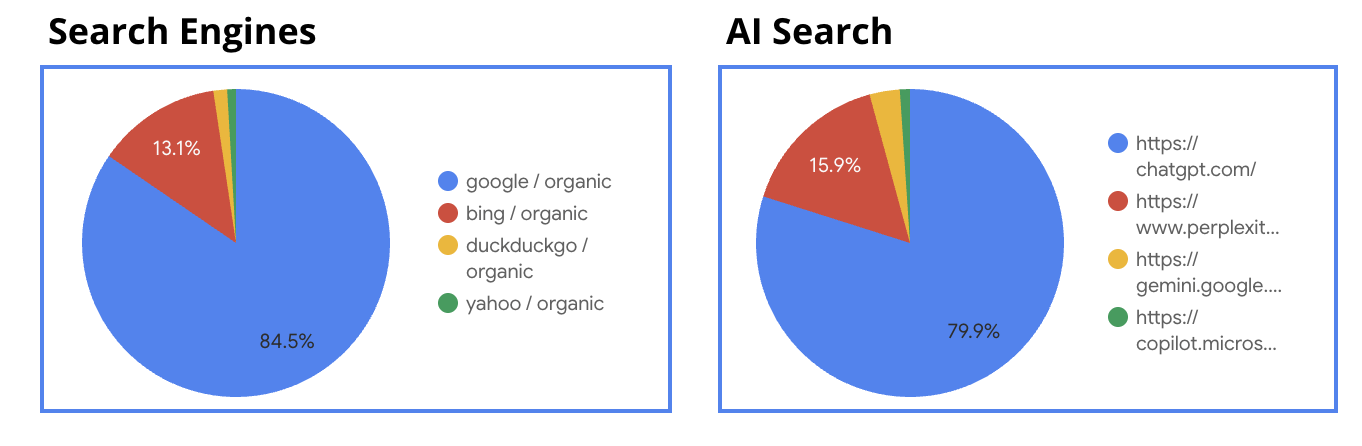
Cybersecurity buyers increasingly use AI tools to compare vendors, define technical concepts, and summarize solution categories. That means cybersecurity SEO now has to account for more than traditional rankings. Content should be structured clearly, cite credible sources, answer specific buyer questions, and build enough topical authority for AI systems to recognize the brand as a useful source.
This does not replace traditional SEO. It builds on the same foundations: technical health, expert content, structured data, internal linking, and authoritative backlinks.
Improve AI Search Visibility with Amplifyed
What to Look For in a Cybersecurity SEO Partner
Not every SEO agency can serve cybersecurity companies effectively. The technical depth required, combined with the scrutiny buyers apply, demands specialized expertise.
Evaluate potential partners on:
- Industry knowledge: Do they understand threat landscapes, compliance frameworks, and buyer personas? Can they speak credibly about SIEM, Zero Trust, and incident response, and the way a cybersecurity firm builds trust with technical buyers?
- Technical SEO capabilities: Can they diagnose and fix complex issues like redirect chains, canonicalization problems, and structured data gaps?
- Content quality: Do they produce accurate, expert-level content, or generic marketing copy dressed up with security keywords?
- Strategic integration: Can they align SEO strategy with your broader demand generation, product marketing, and sales enablement, and digital marketing efforts?
- Proven results: Have they delivered measurable improvements for other cybersecurity companies or cybersecurity clients? Review case studies like our work with Cyware to see real outcomes.
The right partner accelerates your program. The wrong one wastes the budget and can damage your credibility with technical audiences.For guidance on evaluating SEO services, see our complete guide to finding the right B2B SEO partner.
Turn Cybersecurity SEO Into a Growth Engine
Cybersecurity SEO demands specialization. Generic approaches fail because your buyers are too sophisticated and the competition is too intense. Success requires accurate, technically credible content targeting the right keywords at every stage of the buyer journey.
The companies that invest in structured SEO service and content strategy (content hubs, technical foundations, ongoing optimization) experience compounding advantages. They capture demand that competitors miss. They establish trust before the first sales conversation. They turn organic search into a reliable, scalable growth channel, like the 1,100% organic traffic growth we achieved for one tech startup.
Amplifyed works exclusively with cybersecurity and technology companies. We combine deep industry knowledge with technical SEO expertise and content that meets the standards your buyers expect, whether you offer managed security, compliance platforms, threat intelligence, or other cybersecurity services.
Ready to build an SEO program that improves rankings, supports AI search visibility, and drives qualified pipeline? While most cybersecurity SEO is not the same as local SEO, the same principle still applies: your brand needs to appear where the right buyers are searching, comparing, and making decisions.