
Cybersecurity Content Marketing: 2026 GEO + SEO Guide

CISOs and IT leaders increasingly start vendor research inside ChatGPT and AI Overviews, not Google’s top results. This guide covers what’s actually working for cybersecurity companies in 2026: building content that speaks to every stakeholder in the buying committee, not just the CISO, mapping content to each stage of the buyer journey, structuring content so AI engines can cite it, distributing it where security buyers actually spend time, and proving the results to leadership even when attribution is harder than it used to be.
- AI-generated answers now dominate many B2B searches before a buyer ever clicks a link. Search Engine Journal found that B2B technology queries triggered Google AI Overviews 82% of the time as of March 2026, up from just 36% a year earlier.
- Cybersecurity content has to speak to a whole buying committee, not just the CISO. Gartner puts the average complex B2B buying group at 6 to 10 stakeholders, and enterprise cybersecurity deals routinely involve even more.
- Specific, well-structured content compounds into real visibility gains. Amplifyed’s work with Castra added 320 new high-value keywords to their portfolio, the kind of result that comes from the stage-based, specific content this guide recommends.
Why Cybersecurity Content Marketing Looks Different in 2026
Cybersecurity content marketing now has to win two search engines at once: Google, and the LLMs that increasingly answer buyer questions before a click ever happens.
Three shifts make 2026 different from even two years ago.
The Rise of AI Answer Engines (AEO)
AI Overviews and chat-based search now sit above traditional results. According to a Search Engine Journal analysis from March 2026, B2B technology queries triggered AI Overviews 82% of the time — up from 36% just a year earlier. We've watched this play out in our cybersecurity clients' Search Console data. Traditional click-through rates are sliding, but the traffic that does come through is higher intent than ever. This is the core problem GEO solves, earning visibility inside the AI-generated answer itself, not just the blue links underneath.
Larger Buying Committees
Cybersecurity buying committees have grown. Gartner puts the average complex B2B buying group at 6 to 10 stakeholders, and enterprise cybersecurity deals routinely exceed that. Content that only speaks to the CISO will lose the deal at the engineer, compliance officer, or CFO stage.
Fear-Based Messaging Has Stopped Working
Security buyers are tired of FUD. The "your data will be stolen" pitch has lost its punch. IBM's 2025 Cost of a Data Breach Report puts the global average at $4.44 million per breach, down from $4.88M the year before as security AI improved detection times, but leading with fear no longer differentiates anyone. Buyers want clarity, proof, and content that respects their expertise.
The vendors winning today produce content that's deeper, more specific, and easier for AI engines to cite. That's what the rest of this guide is about.
Audit Your Content Against All 5 Decision-Makers
Cybersecurity buying decisions involve an average of 6 to 10 stakeholders. Content that only speaks to the CISO leaves the other seven out of the conversation.
The old playbook was to build a single buyer persona named something like "John the CISO." That approach doesn't fit how cybersecurity decisions actually get made. A CISO may sign the contract, but security engineers vet the technical fit. Compliance officers check regulatory alignment. IT directors worry about integration. CFOs scrutinize the budget. If your content only speaks to one of them, the rest will block the deal.
Inside the Cybersecurity Buying Committee
When we audit content for new cybersecurity clients, the most common gap we find is content depth across roles. Most security sites have plenty for the CISO and almost nothing for the rest of the buying group.
Here's a useful starting point:
Build Modular Content That Serves Multiple Roles
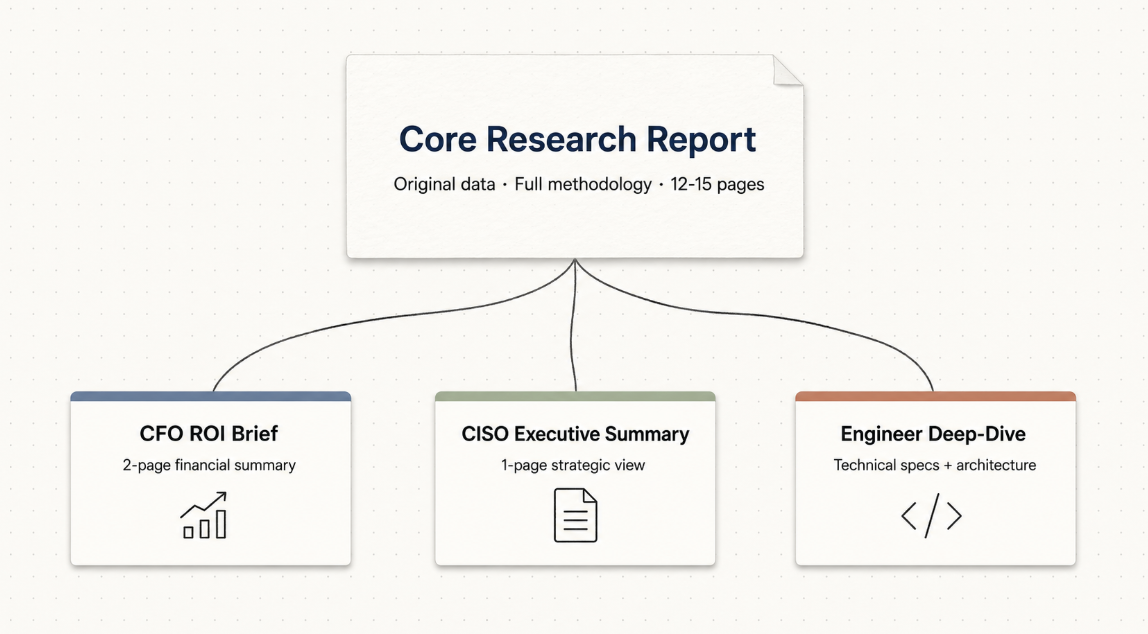
The work is to publish enough variety that each role finds content in their language, without losing brand voice across the set. The simplest way is to produce one core insight per topic, then repackage it. A research report becomes a CFO ROI brief, a CISO executive summary, and a technical engineer deep-dive. Same insight, three formats.
Industry verticals add another layer. A healthcare CISO and a fintech CISO care about different regulations, different threat profiles, and different vendors. Vertical-specific campaigns close more deals than generic ones because they prove you understand the buyer's world.
Map Content to Where Buyers Are in the Journey
Awareness content earns trust, consideration content earns evaluation, and decision content earns the deal. Most cybersecurity vendors only compete at the last stage.
Buyers move through three stages before they're ready to talk to sales. Each one calls for a different content format and depth.
Anonymized Case Studies with Hard Numbers
That last format is the single biggest content lever most cybersecurity teams underuse. Generic case studies ("we helped them improve their security posture") get ignored. Specific case studieswith real outcomes ("reduced critical vulnerabilities by 40% in the first 90 days") outperform generic ones on engagement metrics like time-on-page and form completions.
We've seen this play out in our own work. Cybersecurity clients who switched from generic case studies to anonymized ones with hard numbers saw a clear lift in time-on-page and form completions. The trick is getting customers to agree to specifics. Most won't let you name them, but many will agree to an anonymized version with the numbers intact. "A Fortune 500 financial services company" is enough context for a CISO to recognize themselves in the story.
Vertical-Specific Content Closes More Deals
Industry-specific cybersecurity content, tailored to healthcare, finance, manufacturing, or whatever vertical your customer sits in, is the multiplier on top of stage-based content. Buyers know within a few sentences whether you understand their world.
Publish Content That Wins SEO and GEO at the Same Time
AI Overviews and ChatGPT pull from a small set of trusted sources per query. Most cybersecurity vendors don't appear in any of them.
Search has split into two channels that need different optimization approaches. The good news is they share more DNA than most people assume. Google's own documentation confirms that generative AI features in Search are rooted in the same core ranking and quality systems that drive traditional results. The fundamentals haven't changed, new structural requirements have been layered on top.
What Makes Cybersecurity Content Citable by AI Engines
From our AI search visibility work with cybersecurity clients, we've found a handful of patterns that consistently lift AI citation rates. These are the core GEO tactics (not theoretical best practices) that we test in production every week:
Lead Each Section with a Clear, Atomic Claim
A topic sentence that stands on its own ("Cybersecurity buying committees now average 6 to 10 stakeholders") is easier for an LLM to lift than a paragraph that builds to a point.
Leverage Your Data
Specific numbers tied to named sources (IBM, Gartner, Forrester, your own original research) read as more trustworthy to both AI and human readers.
Use Clean Heading Hierarchy
H1 to H2 to H3 without skipping levels helps AI engines understand which section answers which question.
Keep Publishing Dates Visible
AI engines weigh freshness heavily. A "Last updated" timestamp tells the model your content is current.
Cover Technical and Business Framing in the Same Piece
A single page that covers both the technical depth and the business case is more citable than two narrower pages.
Why AI Visibility Compounds
Showing up in AI search is the wedge most cybersecurity vendors are missing. The companies investing here early are the ones being cited when their competitors are not. AI visibility compounds into shortlist inclusion — if a buyer asks ChatGPT for vendor recommendations and you're not named, you're rarely added back in later.
Traditional SEO still matters. Most pages cited in AI Overviews already rank in the top 10 for the same query, so you're not choosing AI search instead of Google. You're optimizing for both at once.
Distribute Where Cybersecurity Buyers Actually Hang Out
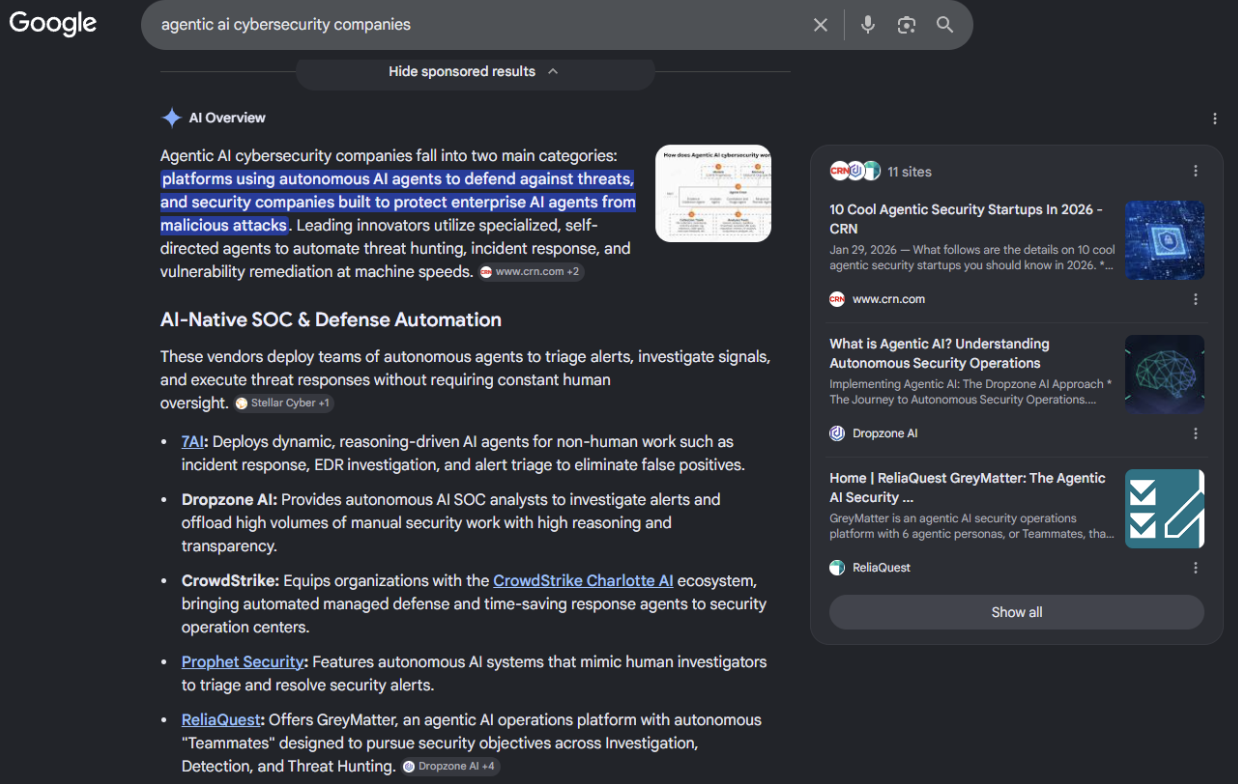
Cybersecurity buyers trust peer recommendations more than vendor content. That means distribution increasingly happens in private communities and Reddit threads, not just on your blog.
Publishing is half the work. The other half is making sure your content reaches buyers in the channels they actually trust. Cybersecurity has a distribution map that looks different from most B2B categories, partly because security buyers are technical and skeptical, partly because they spend more time in private spaces than public ones.
Reddit Is the Channel Most Vendors Get Wrong
We've watched cybersecurity vendors get banned from r/cybersecurity within hours of linking their own blog posts. The platform punishes anything that smells like marketing. The vendors getting Reddit right play a longer game. They build real karma by answering technical questions over months, then earn the right to occasionally share original research. Coordinating that organic participation with targeted Reddit ads is where the channel becomes a serious pipeline source.
Email Is for Nurture, Not Acquisition
Email still has a role, but as a nurture tool for people who already know you. Mailchimp's email marketing benchmarks put the average open rate across industries at 34.23% — strong performance when subscribers chose to hear from you. Cold outreach to CISOs lands nowhere near that. Reserve email for warm subscribers, customer nurture, and opted-in audiences.
How to Prove Your Content Strategy Is Working
Cybersecurity content marketing measurement is harder in 2026 than it has ever been. AI engines don't report which queries cited your content, sales cycles span 12 to 18 months, and the metrics that worked for traditional SEO no longer tell the full story.
Why Measurement Is Harder Right Now

Three structural problems are making this difficult for every cybersecurity marketing team we talk to:
AI Engines and LLMs Don't Share Query Data.
There's no native dashboard from ChatGPT, Perplexity, or Claude showing which queries cited your content. You're flying partially blind on what's working in AI search.
Sales Cycles Outlast Attribution Windows.
Enterprise cybersecurity deals close at 12 to 18 months. Most analytics platforms only credit the first or last touch — they miss everything in between.
Visibility Matters Even Without Clicks.
Being cited in an AI Overview drives no traffic and no form fill, but it still influences shortlist inclusion. Program owners care about this signal, but it doesn't show up in traditional reporting.
How We Approach Reporting at Amplifyed
We won't pretend the measurement gap is solved. It isn't. What we do is build a methodology that gets as close to the truth as the current tooling allows:
- We test specific tools and tactics, then keep what works and ditch what doesn't
- We establish baseline benchmarks early so growth is visible against a real starting point, not a guess
- We pair traditional metrics with AI visibility tracking and report on both, weighted to context
- We acknowledge what we can't measure (yet) instead of overpromising attribution we can't deliver
Five Numbers That Predict the Pipeline
1. AI Citation Frequency
The new top-of-funnel signal — and the single most important GEO metric. Choose a tracking tool (Profound, Ahrefs Brand Radar, Otterly.ai, Gumshoe) and pick a set of prompts and queries that match your ICP's actual search behavior. Tracking the same prompts weekly gives you a 1:1 comparison over time and removes the noise of LLM variability.
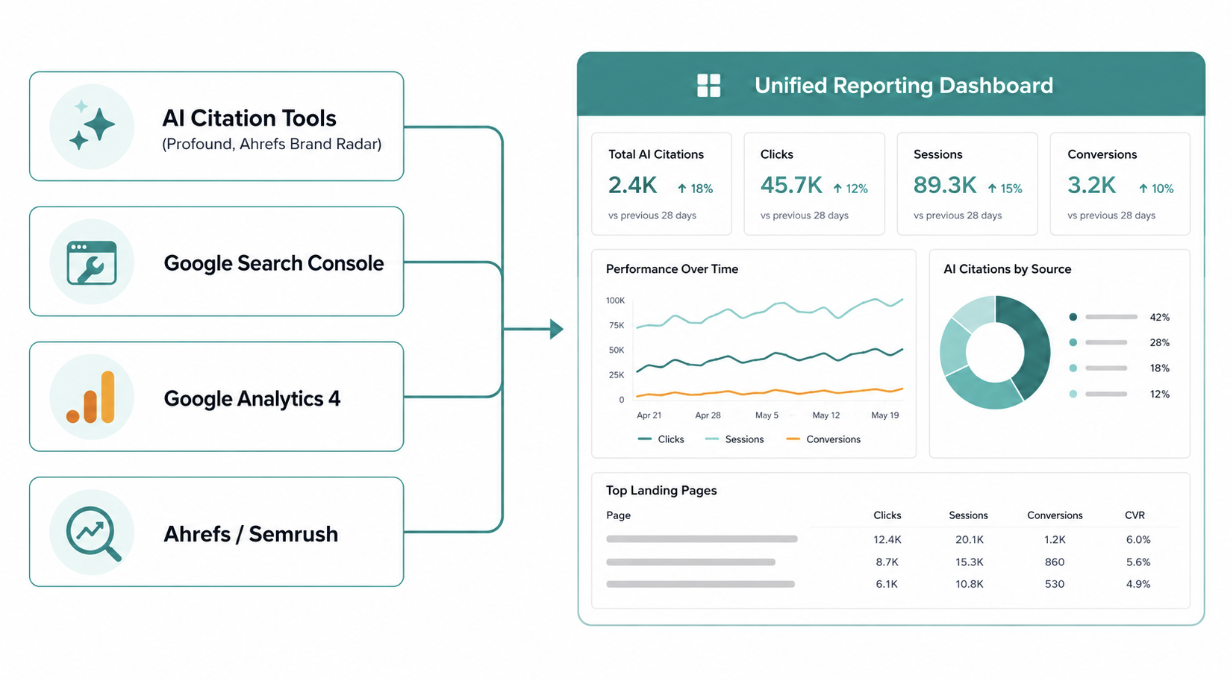
No single tool gives you the full picture. The real value comes from stitching multiple sources together: GA4 for site behavior, GSC for traditional query data, your citation tracker for AI visibility, and Ahrefs for competitor benchmarks. Build a dashboard that lets you read across all four, and you'll spot what's working before any single metric tells you. At Amplifyed, this is the reporting setup we build for every cybersecurity client, because watching the data tell a story beats checking four platforms.
2. Branded Search Growth
A leading indicator that AI visibility is paying off, especially when AI mentions don't drive direct clicks. If people are encountering your brand in ChatGPT and searching your name later, branded search climbs before any other KPI moves.
3. Organic Traffic by Intent
High-intent search terms (specific products, frameworks, comparisons) matter more than total sessions. Total traffic is a vanity number. Traffic from queries your ICP actually uses is pipeline fuel.
4. Influenced Pipeline
Opportunities where prospects touched two or more content pieces before talking to sales.
Helpful tip: Add a "How did you hear about us?" field on your lead forms with options like "ChatGPT or AI tools," "Google search," "LinkedIn," and "Referral." Self-reported AI attribution is the closest signal you'll get to what analytics can't capture.
5. Content-Assisted Deals
Closed-won deals where multiple pieces of content showed up in the buyer's journey, even if no single piece was the first or last touch. To actually track this, ask your sales team to log "what content did you read before this call?" during discovery, and capture content touchpoints in your CRM. Imperfect, but directional.
What to Say When Leadership Asks "Is This Working”?
If you're a marketing lead defending your content program to a CEO or CFO, three things hold up under pressure:
- Tie content metrics to OKRs and pipeline forecasting, not just MQL counts. AI visibility, branded search, and influenced pipeline map to revenue OKRs more credibly than blog traffic ever did.
- Report monthly, judge quarterly. Monthly data has too much noise. Quarterly trends reveal the real pattern.
- Be transparent about what you can and can't measure. "Here's what we know, here's what we're estimating, here's what we can't measure yet" earns more credibility than assuming attribution.
The marketing leaders who win the internal argument are the ones who treat content like a CAC-reduction investment that compounds.
The Honest ROI Timeline
We've tracked content marketing performance across cybersecurity clients for years, and the timeline is remarkably consistent:
- Months 1 to 3: Strategy, production, no visible search results yet.
- Months 4 to 6: First content starts ranking. Pipeline influence begins.
- Months 7 to 12: Compound growth. Organic traffic doubles. Branded search grows. Sales starts referencing content in deals.
- Months 12 to 24: Content becomes a primary lead source. Customer acquisition cost meaningfully drops as the organic pipeline starts replacing paid channels.

Any vendor expecting a pipeline in 90 days will either give up early or pressure the team into short-term tactics that don't work. Patience is the unfair advantage in this category.
How to Start (or Amplify) Your Cybersecurity Content Program
A working cybersecurity content program in 2026 starts with three moves:
- A — Audit what you have
- M — Map your content to buyer intent
- P — Publish original research pieces
The audit shows you what's already working and what's quietly decaying. Mapping reveals which queries are sending buyers to competitors in AI engines instead of you. Original research, even a small piece, gives you a citation magnet that other publications, AI engines, and prospects all reference.
Each step is doable on your own. Doing all three well while running everything else is where most cybersecurity teams stall.
That's where Amplifyed comes in. We're an SEO and GEO agency built for cybersecurity vendors. We get security companies cited in LLMs, ranked for queries that convert, and build content programs that compound over 12 to 24 months.
Free 20-minute call. Walk away with three SEO and GEO opportunities specific to your site, yours whether we work together or not.