
SEO vs. GEO: How Cybersecurity Brands Get Found in AI Search

Cybersecurity buyers now increasingly research vendors through AI chat bots like ChatGPT, Claude, Grok, and Google AI Overviews, not just Google. This guide covers how SEO and GEO work together to earn visibility across both: what it means for a brand to be referenced, cited, and clicked in AI search, how to track GEO performance, which content formats and technical foundations support AI visibility, and the most common mistakes that hold cybersecurity brands back.
- Different AI platforms cite different sources, so visibility on one doesn’t guarantee visibility everywhere. Ahrefs analyzed the top 50 most-mentioned sources across Google AI Overviews, ChatGPT, and Perplexity and found 86% weren’t shared across all three, meaning a brand cited by one AI tool can be invisible to another.
- Strong SEO and GEO work compounds across a brand’s full content footprint. Amplifyed clients have seen results like a 267% increase in organic traffic after aligning content, technical SEO, and AI-readable structure together.
- Visibility share is one of the clearest ways to track whether this work is paying off. Amplifyed has helped clients achieve a 64% lift in overall keyword visibility, the same kind of signal this guide recommends tracking across AI platforms.
Cybersecurity buyers are no longer using only Google to compare vendors, research solutions, or understand technical topics. They are also asking ChatGPT, Claude, Grok, and Google AI Overviews to shortlist providers, summarize options, and find answers faster.
This article explains how SEO and GEO work together, what it means to be referenced, cited, and clicked in AI search, and how cybersecurity brands can improve visibility across both search engines and AI-generated answers.
What Is GEO, and How Is It Different From SEO?
GEO, or generative engine optimization, is the process of optimizing content so it can appear inside AI-generated search experiences. Instead of focusing only on traditional rankings, GEO looks at whether your brand can be referenced, cited, or clicked in tools like ChatGPT, Claude, Grok, Perplexity, and Google AI Overviews.
Unlike a replacement for SEO, generative engine optimization builds on the same foundations. Strong organic rankings, useful content, backlinks, internal links, schema, and technical SEO still matter because AI systems often pull from sources already trusted across search. In simpler terms, SEO helps your brand rank in search engines, while GEO helps AI systems understand, trust, summarize, and surface your content in generated answers.
What It Means to Be Referenced, Cited, and Clicked in AI Search
AI search visibility is not just about getting a blue link or ranking in a fixed position. In AI-generated answers, your brand can appear in different ways depending on how the tool interprets the query, which sources it trusts, and what information it chooses to include. Each level can help your brand, but the real value comes when they work together.
- Reference: The AI tool names your company in its response, such as recommending your brand as a cybersecurity vendor for a specific solution category. This helps build awareness because the buyer sees your brand included directly in the answer.
- Citation: The AI tool sources information from your content or from another trusted source mentioning your company. This signals trust because the tool is using your brand, page, or third-party mention to support its response.
- Click: The user clicks through from the AI-generated answer to your website, product page, blog post, or landing page. This is where AI visibility can turn into measurable traffic, engagement, and potential pipeline.
The strongest GEO outcome happens when your brand is referenced, cited, and clicked in the same search journey. By the time the buyer lands on your site, they may already understand why your company is relevant, which can make that visit more qualified than a generic organic click.
Learn more about our GEO services.
Why AI Search Can Drive High-Intent Cybersecurity Leads
Traditional search queries are often short and broad. Someone may type “hardened images” into Google, but that does not show whether they want a definition, technical guide, product, or vendor list. AI prompts tend to be more specific, such as asking for container image security vendors that offer hardened base image registries for financial services.
That extra context can reveal the buyer’s industry, use case, solution needs, and stage of evaluation. For cybersecurity companies, this means AI search may produce fewer visits than Google, but the leads can be more qualified because the buyer is often closer to comparing vendors or making a shortlist.
How to Measure GEO Performance
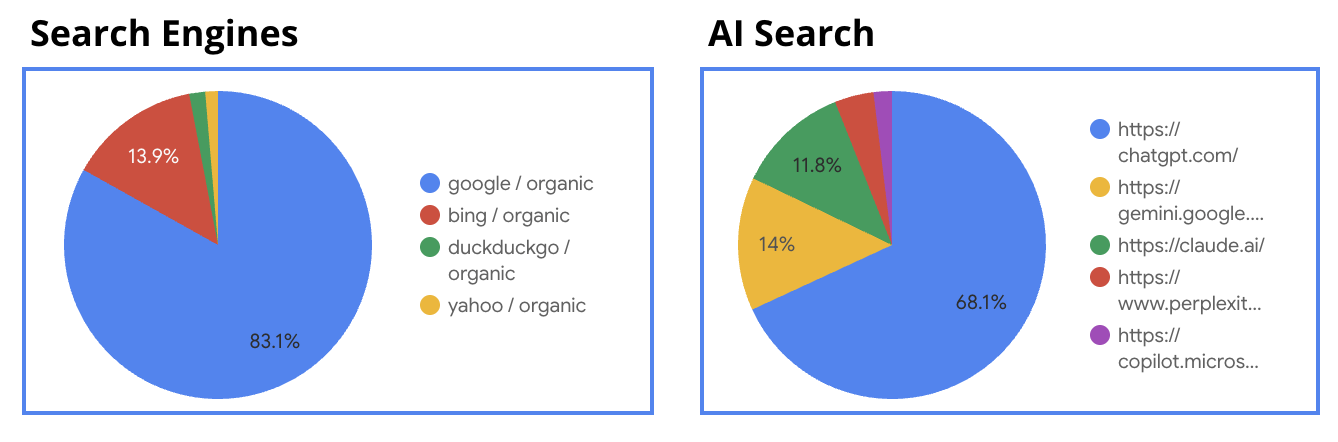
GEO reporting is messier than traditional SEO reporting because AI search does not always give you a clean source path. A buyer may see your brand in ChatGPT, search your company name later, then visit your site directly, which means AI influenced the journey even if analytics does not show a direct referral click.
GEO Metrics to Track
Because AI visibility does not always show up as a clean referral click, cybersecurity teams need to look at a wider set of signals. The goal is to understand whether your brand is becoming more visible, more trusted, and more frequently included in the AI-generated answers your buyers use during research.
Useful GEO metrics include:
- Brand mentions: Track how often AI tools mention your company in generated answers.
- Citations: Monitor when AI tools use your website or third-party sources mentioning your brand.
- AI referral clicks: Measure the traffic that comes directly from AI-generated answers when links are available.
- Visibility share: Compare how often your brand appears against competitors for buyer-relevant prompts.
- Branded search growth: Watch whether more people search for your company after AI visibility improves.
- Conversions from AI-referred visitors: Track whether AI-driven traffic leads to demos, downloads, form fills, or other conversion actions.
Tools like Profound, Otterly, Ahrefs, and SEMrush can help monitor AI visibility, competitor mentions, and share of voice. Avoid measuring success by one fixed prompt. A better approach is to track a broader set of buyer-relevant prompts and compare your visibility against competitors over time.
Content Strategies That Improve AI Search Visibility
One of the fastest ways to improve AI search visibility is to refresh existing content. Many cybersecurity brands focus heavily on new blog posts, but older pages with existing traffic, page-two rankings, backlinks, ranking history, or clear business value often have more immediate potential because they may only need better structure, fresher data, clearer sources, stronger internal links, or more direct answers to buyer questions.
Study What AI Already Trusts
Search buyer-style prompts in a clean browser or AI session, then look at what gets cited. If the sources are listicles, third-party “best vendor” lists, product pages, comparison articles, or educational guides, use those patterns to guide your content strategy and decide whether you need stronger solution pages, better comparison content, or placements in trusted third-party sources.
Cybersecurity-Specific Content That Performs Well in GEO
Cybersecurity search behavior is often specific. Buyers search by use case, industry, compliance requirement, competitor, feature, threat type, or technical workflow. That means a general blog strategy is not enough.
Several content formats tend to perform well for cybersecurity SEO and GEO:
- Comparison pages: Help buyers compare vendors, platforms, features, pricing models, and use cases.
- Listicles: Work well for “best,” “top,” and “leading provider” searches.
- Vendor alternative pages: Capture buyers comparing a known competitor against other options.
- FAQ pages or FAQ sections: Give AI systems clear answers to specific buyer questions.
- Compliance content: Attract buyers searching for SOC 2, HIPAA, KYC, CMMC, GDPR, or similar requirements.
- Industry pages: Help brands rank for vertical-specific searches, such as fintech, healthcare, manufacturing, government, or gaming security.
- Feature pages: Target specific product capabilities like phishing prevention, malware detection, API security, or cloud monitoring.
- Glossaries: Build topical depth by defining cybersecurity terms, frameworks, threats, and technologies.
- Threat alerts: Show freshness and authority by covering vulnerabilities, attack trends, and emerging threat activity.
These formats work best when they are connected instead of treated as one-off pages. A strong GEO strategy should link related content together so AI systems can understand how your brand connects to specific industries, buyer questions, compliance needs, and solution categories.
Why Specificity Matters
Compliance and industry-specific content can be especially powerful. A buyer may not search for a generic cybersecurity solution. They may ask for vendors that help fintech companies meet SOC 2 requirements or tools for healthcare organizations managing HIPAA risk. That level of specificity gives your brand a chance to show up for niche, high-intent searches. But AI systems need enough context to connect your company with those needs.
.png)
Blog and Page Checklist for SEO and GEO
Create each cybersecurity page with both readers and crawlers in mind. The goal is to make the content easy to scan, easy to understand, and easy for AI systems to interpret.
A strong page should include:
- Clear heading structure: Use one H1 for the page title, H2s for major sections, and H3s for supporting points. This helps readers follow the flow and helps crawlers understand how each topic connects.
- Scannable formatting: Break up long sections with short paragraphs, bullets, tables, images, comparison blocks, and examples. This makes technical content easier to process, especially for buyers reviewing complex cybersecurity information.
- Trust-building elements: Add expert author bios, credible sources, current statistics, and proof points where relevant. These signals help show that the content is accurate, current, and backed by real expertise.
- Natural FAQs: Answer real buyer questions in plain language instead of forcing keywords into awkward phrasing. FAQs work best when they clarify specific concerns buyers have during research or evaluation.
- Internal links: Connect related blog posts, service pages, feature pages, case studies, and industry pages. This gives users a clearer path through the site and helps AI systems understand topical relationships.
- Strong CTAs: Place clear next steps throughout long-form content, especially on pages designed to support demos, downloads, or sales conversations. The CTA should match the reader’s stage, whether they are ready to book a call or still comparing options.
When these elements work together, the page becomes more useful for human readers and easier for AI systems to parse. That combination improves the chances of being understood, cited, and trusted across traditional search and AI-generated answers.
Technical SEO Foundations That Support GEO
Technical SEO is one of the most important foundations for GEO because AI systems need to access, crawl, and understand your pages before they can surface them in generated answers. Start by reviewing robots.txt settings, noindex tags, crawl permissions, XML sitemaps, and AI crawler access. One incorrect directive can block important pages from search engines or AI tools.
High-value product, feature, industry, and blog pages should be accessible, crawlable, and easy to find. If they are blocked, orphaned, slow, or buried too deep in the site, AI systems may not reach them. Internal linking also matters because crawlers use links to understand how topics connect, while fast-loading pages can support crawlability, user experience, and citation potential.
Why Schema Markup Matters for AI Visibility
Schema markup is structured data added to a page to help search engines understand its meaning. It gives crawlers extra context about your company, content, author, product, software, FAQs, and site structure. For GEO, schema matters because it helps AI systems interpret information more accurately, almost like giving search engines a clearer map of what each page means.
Cybersecurity brands should prioritize schema types such as:
- Organization schema — Helps search engines understand your company identity, website, and brand entity.
- Article schema — Adds context to blog posts, guides, and educational content.
- FAQ schema — Helps clarify question-and-answer content on service, product, or resource pages.
- SoftwareApplication schema — Gives search engines more context about cybersecurity platforms or software products.
- Product or Service schema — Supports pages focused on specific solutions, offerings, or service categories.
- Breadcrumb schema — Helps search engines understand page hierarchy and site structure.
Schema will not rescue weak content, but when the content is already useful, it can help search engines and AI systems understand the page faster and more accurately.
Authority and Trust Signals That Support AI Rankings
AI systems do not evaluate your content in isolation. They also look at how the broader web talks about your company, which means authority and trust signals can influence whether your brand is surfaced in AI-generated answers. These signals can include backlinks, PR mentions, analyst mentions, reviews, Reddit discussions, industry association mentions, best-of list placements, unlinked brand mentions, third-party directories, and cybersecurity community references.
Relevance Matters More Than Volume
In cybersecurity, relevance matters more than raw authority. A mention from a niche cybersecurity publication, trusted industry association, or relevant community can be more valuable than a link from a large but unrelated website, while earned media, expert commentary, podcast appearances, industry reports, and third-party reviews can all help build a stronger web footprint around your market, audience, and solution.
Conversion Tips for Cybersecurity SEO and GEO Traffic
Search visibility only matters if the page gives visitors a clear next step. Many cybersecurity websites rely too heavily on one “Get a Demo” button in the navigation, but long-form pages often need CTAs throughout the content. Not every visitor is ready for a demo, either. Some are comparing options, building a business case, educating a team, or trying to understand the category before speaking with sales.
CTA Ideas for Complex Sales Cycles
Useful CTA options include booking a demo, watching a demo video, downloading a guide, viewing a comparison page, reading a case study, getting a technical checklist, requesting an assessment, talking to an expert, joining a webinar, or subscribing to threat alerts.
CTA design matters too. Demo buttons should stand out visually, and demo pages should explain what the prospect will see, what they will learn, and why the call is worth their time.
.png)
Common SEO and GEO Mistakes Cybersecurity Brands Make
Many cybersecurity companies have strong products, experienced teams, and clear market value, but their websites do not always communicate that strength in a way search engines or AI systems can easily understand. Small issues like missing schema, unclear structure, weak CTAs, or thin topical coverage can reduce visibility even when the underlying offer is strong.
Common SEO and GEO weaknesses include:
- Missing schema: Makes it harder for search engines and AI systems to understand the page, business, content type, and FAQs.
- Poor page structure: Weak heading hierarchy, long sections, or unclear formatting can make content harder to crawl, scan, and cite.
- Weak product-page terminology: Product pages may sound polished but fail to use the actual terms buyers search for.
- Limited topical depth: Thin coverage around core services, features, industries, or compliance topics can weaken authority.
- Page-specific FAQ gaps: Missing FAQs on relevant service or solution pages can reduce AI visibility and leave buyer questions unanswered.
- Text-heavy pages: Large blocks of copy make content harder for readers and AI systems to process quickly.
- Weak CTAs: Generic or hard-to-find CTAs can reduce conversions even when traffic is strong.
- Missing author bios: Lack of expert attribution can weaken trust, especially for technical cybersecurity content.
- General FAQ pages: Broad FAQ pages are less useful than placing specific questions directly on the most relevant solution or feature pages.
These issues are usually fixable without rebuilding the entire site. The best starting point is to improve the pages closest to revenue first, such as product pages, comparison pages, high-intent blog posts, industry pages, and demo paths.
Why Slow Execution Hurts
Cybersecurity teams sometimes wait too long to publish, test, or update content because they want every page to be perfect. Quality matters, but perfection can delay progress, especially in SEO and GEO where visibility improves through testing, monitoring, and iteration. Publish a strong version, track performance, then improve it with better FAQs, clearer comparisons, fresher data, schema, stronger CTAs, and internal links.
Turn SEO and GEO Into a Competitive Advantage
SEO and GEO should not be treated as separate strategies. For cybersecurity brands, the same fundamentals support both: clear content, technical health, schema, internal links, topical depth, authority signals, and conversion paths. When these pieces work together, your brand becomes easier for search engines and AI systems to understand, trust, and surface.
Amplifyed helps cybersecurity companies strengthen that foundation across Google, AI Overviews, ChatGPT, Claude, and other search experiences buyers now use to compare solutions. With the right strategy, your content can do more than rank. It can help your brand get referenced, cited, clicked, and considered by the right buyers.
FAQs